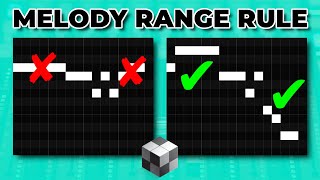
Range Rule for Better Melodies
Channel: Hack Music Theory
Category: Education
Tags: melody range rulemelody rulesmelody writing ruleswriting better melodieshow to make melodieshack melodiesmusic theory melodyhow to make melodies music theorymelody writing theorymelody rangehow to write a melodyhow to write better melodiesmelody tutorialhack music theory melodymusic theory melody writingmelody writinghow to write a melody for beginnershack music theorybetter melodieshow to make better melodiesmelody rules music theory
Description: Learn how to avoid this common fault many songwriters and producers make in their melodies! ►FREE Book: HackMusicTheory.com/Books ►Songwriting & Producing PDF: HackMusicTheory.com/Bestsellers 0:00 Introduction 1:15 The Fault 2:21 The Fix 2:41 Step 1. Climax 3:01 Step 2. Highest 3:40 Step 3. Lowest 4:05 Step 4. Contour 5:04 The Rule 5:35 The Example 5:56 The Djend THE FAULT Firstly, just to clarify. A fault is not a mistake! A fault is a weakness. In other words, an area for improvement. So, what’s the fault in this melody? Well, the melody’s range is too small. The range of a melody is the interval from its lowest note (C) to its highest note (F). In this melody, that distance is only five semitones. That’s small! Listening to a melody with a small range is like listening to a person talking who doesn’t vary their pitch. It’s monotonous, which gets boring! So, just like in speech, a big range will bring interest and life into your melodies. And by the way, our example is in the key of F Lydian, which is all the white notes from F to F, and the tempo is 90 BPM. And if you’re not familiar with the Lydian mode, you can use the Mode Hack in our Songwriting & Producing PDF (link above). THE FIX Okay, so now that you can identify the fault, how do you fix it? Well, it’s shockingly easy to fix, as you simply need to move the MIDI notes up and down to extend your melody’s range. In practice, however, it’s a little more tricky than that. So, here’s our step-by-step method for creating a big range in your melodies. STEP 1. CLIMAX Start by deciding where the climax of your melody will happen (i.e. the highest note). Using the concept of counterpoint, we suggest playing your melody’s highest note over your bass line’s lowest note, or at least one of its lowest notes. We chose to play our highest note over the first chord, Fmaj. STEP 2. HIGHEST Once you know where your highest note is going, you need to decide on what that note will actually be. A good place to start is with the 3 of your chord below, because the 3 is the most powerful note*. For example, over an Fmaj chord, the 3 is the note A. And obviously you don’t have to use the 3 as your highest note, it’s just a good note to get your creative juices flowing. We actually used the 2 as our highest note. So over the Fmaj chord, that’s G. *To learn why the 3 is the most powerful note, read Hack 9 in our free book (link above). STEP 3. LOWEST Next, do the opposite: Decide on where the lowest note of your melody is going, and what it will be. We suggest playing your melody’s lowest note over your bass line’s highest note, or at least one of its highest notes. STEP 4. CONTOUR Now that you’ve got your highest and lowest notes in place, you can create a flowing contour to join them up. If you want a big jump in your contour, that’s awesome, but use those large intervals very sparingly, as they can be overwhelming. For most of your melody, you’ll want to use smaller intervals. IDEAL RANGE Right, now you’re probably wondering: What’s the ideal range for a melody? Well, just like every person in the world is different, every melody is different too. So while there’s no one-size-fits-all range that’s ideal, you’ll know when your melody’s range is too small, because it will be boring and lifeless. And you’ll know when your melody’s range is too big, because it will be really difficult to sing. Somewhere between those two guidelines is where you’ll find the ideal range for each melody. And yes, your melody should be singable even if you’re writing it for synth, or guitar, or some other instrument. Great melodies are singable melodies! Always. THE RULE So to conclude. Our Melody Range Rule is that your melody must have a big enough range to keep it interesting and full of life, but not too big so that it’s hard to sing. Lastly, if you need more help writing melodies, then simply use our Melody Checklist, which tells you exactly what to do and what not to do in your melodies. The Melody Checklist can be found in our Songwriting & Producing PDF (link above). --- ABOUT Hack Music Theory is the fast, easy and fun way to make music. Taught by multi-award-winning music lecturer Ray Harmony, and his protégé wife Kate. Ray started teaching music theory in 1995, and has made music with Serj Tankian (System Of A Down), Tom Morello (Rage Against The Machine), and more! COPYRIGHT & CREDITS © 2022 Revolution Harmony Revolution Harmony is Ray Harmony & Kate Harmony Script & all music in video by Revolution Harmony Book promo filmed & edited by Maurits Nienhuis All stock footage courtesy of Pexels