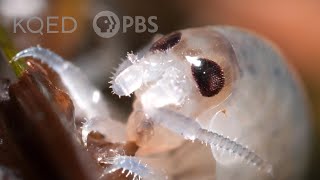
Flea.
Channel: My Own Amazing Body
Category: Howto & Style
Tags: pulgapuce humaineلدغة برغوثpicadura de pulgafleas biteблошиный укусमानव पिस्सूfleahuman fleabiteノミinsectbite bite fleamordida de pulgafleasبرغوث الإنسانbite flea인간 벼룩insect bitebọ chétnomiノミバイトpicaduraparasitemenschlicher flohflea bite
Description: Flea, the common name for the order Siphonaptera, includes 2,500 species of small flightless insects that survive as external parasites of mammals and birds. Fleas live by consuming blood, or hematophagy, from their hosts. Adult fleas grow to about 3 mm (0.12 in) long, are usually brown, and have bodies that are "flattened" sideways or narrow, enabling them to move through their host's fur or feathers. They lack wings, but have strong claws preventing them from being dislodged, mouthparts adapted for piercing skin and sucking blood, and hind legs extremely well adapted for jumping. They are able to leap a distance of some 50 times their body length, a feat second only to jumps made by another group of insects, the superfamily of froghoppers. Flea larvae are worm-like with no limbs; they have chewing mouthparts and feed on organic debris left on their host's skin. The Siphonaptera are most closely related to the snow scorpionflies, or snow fleas in the UK, formally the Boreidae, placing them within the Endopterygote insect order Mecoptera. Fleas arose in the early Cretaceous, most likely as ectoparasites of mammals, before moving on to other groups, including birds. Each species of flea is more or less a specialist with respect to its host animal species: many species never breed on any other host, though some are less selective. Some families of fleas are exclusive to a single host group; for example, the Malacopsyllidae are found only on armadillos, the Ischnopsyllidae only on bats, and the Chimaeropsyllidae only on elephant shrews. The oriental rat flea, Xenopsylla cheopis, is a vector of Yersinia pestis, the bacterium which causes bubonic plague. The disease was spread to humans by rodents such as the black rat, which were bitten by infected fleas. Major outbreaks included the Plague of Justinian, c. 540 and the Black Death, c. 1350, both of which killed a sizeable fraction of the world's population. Fleas appear in human culture in such diverse forms as flea circuses, poems like John Donne's erotic The Flea, works of music such as by Modest Mussorgsky, and a film by Charlie Chaplin. Fleas are a pest species to their hosts, causing an itching sensation that results in discomfort and leads to scratching in the vicinity of the bite. Flea bites generally cause the skin to raise, swell, and itch. The bite site has a single puncture point in the center. Bites often appear in clusters or small rows and can remain inflamed for up to several weeks. This species bites many species of mammals and birds, including domesticated ones. It has been found on dogs and wild canids, monkeys in captivity, opossums, domestic cats, wild felids in captivity, chickens, black rats and Norwegian rats, wild rodents, pigs, free-tailed bats, and other species. It can also be an intermediate host for the flea tapeworm cestode Dipylidium caninum. Fleas can spread rapidly and move between areas to include eyebrows, eyelashes, and pubic regions. Hair loss as a result of itching is common, especially in wild and domestic animals. Anemia is also possible in extreme cases of high-volume infestations.