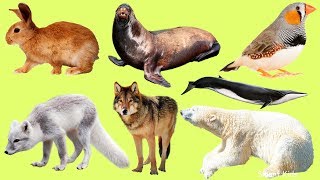
Polar Bears Explained
Channel: What Lurks Below
Category: Education
Tags: artic animals soundspolar bear factspolar bears fightingpolar bear huntingwhat lurks belowarctic animalswinter animalspolar bear explainednorth polepolar bearspolar bears swimmingoceans explainedpolar bearwhat lurks underneathpolar bear facts for kidspolar bear encounterpolar bear attacksthings you did not know about polar bearspolar bears hunting humanswild animals explainedanimals explained
Description: Pola Bears Explained! Learn everything you did not know about these hyper carnivorous bears & biggest species of the Arctic Circle. SUBSCRIBE for the latest videos: goo.gl/7xzjzR #17. Scientists can extract polar bear DNA from their footprints Under normal circumstances, to obtain DNA information from an animal, scientists will need biological samples like their hair, saliva, or blood. And getting those samples from a live bear, one of the most ferocious carnivores in the world, is no easy task. #16. They can live for up to 30 years in the wild Polar bears can live up to 30 years in the wild. But even so, they typically average 25 years of life. The oldest wild and captive polar bears on record died at 32 years and 43 years, respectively. #15. Polar bears can overheat Homeostasis is an important function of life. It ensures that animals can keep things like heat and water in balance. When it comes to heat in particular, humans are great at regulating it. Our sweat helps us cool our bodies. But unlike humans, polar bears do not sweat. And so, they run the risk of overheating if they exert themselves too much. #14. They struggle to find food Despite the fact that polar bears have great adaptations for hunting in both terrestrial and aquatic environments, they struggle to find food. This is less of a problem with them and more of a problem with their environments. #13. Their hairy paws facilitate movement Polar Bears have their entire bodies covered by fur. This fur extends across their paws. Unlike the fur everywhere else on their bodies, the fur on paws doesn't just exist to keep them warm. Rather, it allows them to move skillfully on ice. #12. They are marine mammals Polar bears are formerly classified as marine mammals. This puts them in the same group as other creatures like whales and dolphins. However, unlike those other two, polar bears are much better suited for terrestrial living as well as aquatic. #11. They tend to migrate in search of food Polar bears tend to migrate large distances in search of food. As the seasons change and the ice melts, they will migrate within their individual "home range." This will often range between 50,000 square miles to 135,000 square miles. That's about half the area of the state of Texas. #10. Only pregnant polar bears hibernate in winter Other species of bears, such as black bears and grizzly bears, are infamous for hibernating. During hibernation, these animals enter periods of deep sleep so as to survive adverse environmental conditions such as cold or the lack of prey. Polar bears do not have the ability to hibernate, unlike their counterparts. #9. They have an extremely strong sense of smell Among the various specialties and skills that polar bears have, their sense of smell is at the very top of that list. They have a potent sense of smell that allows them to detect prey up to 1 mile away. They can also detect prey buried up to beneath snow. #8. They are great divers Since polar bears are marine mammals, they do a fair amount of hunting underwater. For this reason, they are great divers. They can dive up to 15 feet beneath the surface of the water. #7. They are the largest land carnivores in the world Polar bears are the largest land carnivores in the world. These creatures tend to average weights of 770 pounds to 1500 pounds. T #6. There are 19 sub-populations of polar bears There are 19 discrete subpopulations of polar bears on Earth. As of 2019, one of these subpopulations is in decline, two are increasing, seven are stable, and nine have insufficient data. Putting a number to these estimates, between 22,000 and 31,000 polar bears exist on Earth today. #5. They sometimes hybridize with grizzly bears Have you ever heard of a pizzly bear or a grolar bear? These creatures are hybrids between polar bears and grizzly bears. They have been bred both in captivity and in the wild. #4. They are hypercarnivores We've already said much about polar bears being apex predators. But in addition to this, they are hypercarnivorous creatures. Hypercarnivores have a diet that is comprised of at least 70% meat. Polar bears can eat between 10 to 20 percent of their body weight at a time. #3. They love to eat seals As you may have gathered by now, seals are the favorite meal of polar bears. Seals are so essential to the diet of polar bears that seal populations and seal migration patterns also affect polar bears. #2. They are decent swimmers This shouldn't come as a surprise since we have emphasized that polar bears are aquatic mammals. They are quite adept at movement both on land and in water. Polar bears can swim at average speeds of 6 miles per hour. #1. They have black skin This fact about bears may cause more than a few people to raise their eyebrows. After all, polar bears clearly look white. The fact of the matter is, this white color comes from the nature of their furs.