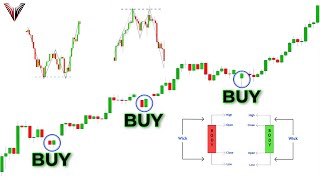
#5. How to Trade Doji Candlestick Pattern in intraday?
Channel: Mahendra kori
Category: Education
Tags: doji candlestickdoji candlestick pattern hindistock trading for beginnersdoji candledoji candlestick kya haidoji candle kya hota haidojidoji candlestick technical analysiscandlestick analysis in hindistock marketcandle chart analysisdoji candle technical analysisdoji candlestick typesdoji candlestick pattern intradaydoji candlestick patternstock market indiain hindicandlestick patternsdoji patternmahendra kori
Description: Candlestick Pattern Playlist link:- youtube.com/c/Mahendrakori/playlists 00:00 Doji Candle kya hai? 05:13 Doji Candle Chart par Kaise kaam karta hai? 10:08 Doji Candle on the second chart 17:01 Last part A Doji is a name for a session in which the candlestick for security has an open and close that are virtually equal and are often components in patterns. Doji candlesticks look like a cross, inverted cross, or plus sign. Alone, doji are neutral patterns that are also featured in a number of important patterns. A doji candlestick forms when a security's open and close are virtually equal for the given time period and generally signals a reversal pattern for technical analysts. A doji, referring to both singular and plural forms, is created when the open and close for a stock are virtually the same. Doji tends to look like a cross or plus sign and have small or nonexistent bodies. From an auction theory perspective, doji represent indecision on the side of both buyers and sellers. Everyone is equally matched, so the price goes nowhere; buyers and sellers are in a standoff. Some analysts interpret this as a sign of reversal. However, it may also be a time when buyers or sellers are gaining momentum for a continuation trend. Doji is commonly seen in periods of consolidation and can help analysts identify potential price breakouts. In isolation, a doji candlestick is a neutral indicator that provides little information. Moreover, a doji is not a common occurrence; therefore, it is not a reliable tool for spotting things like price reversals. When it does occur, it isn't always reliable either. There is no assurance the price will continue in the expected direction following the confirmation candle. The size of the doji's tail or wick coupled with the size of the confirmation candle can sometimes mean the entry point for a trade is a long way from the stop loss location. This means traders will need to find another location for the stop loss, or they may need to forgo the trade since too large of a stop loss may not justify the potential reward of the trade. There is three types of Daji Candle: 1. Dragonfly Doji Candle 2. Gravestone Doji Candle 3. Long Legged Doji Candle GRAVESTONE DOJI CANDLE: A gravestone doji candle is a type of pattern that technical stock traders use as a signal that a stock price may soon undergo a bearish reversal. This pattern forms when the open, low, and closing prices of an asset are close to each other and have a long upper shadow. The shadow in a candlestick chart is the thin part showing the price action for the day as it differs from high to low prices. While traders will frequently use the gravestone doji as a signal to enter a short position or exit a long position, most traders will review other indicators before taking action on a trade. The reason for this is that the gravestone doji pattern is not always a reliable indicator of a reversal. Many traders will look at the next day's candle to confirm the reversal (along with other technical indicators) before initiating a trade. Long-Legged Doji Candle:- The long-legged doji is a type of candlestick pattern that signals to traders a point of indecision about the future direction of a security's price. This doji has long upper and lower shadows and roughly the same opening and closing prices. In addition to signaling indecision, the long-legged doji can also indicate the beginning of a consolidation period where price action may soon break out to form a new trend. Long-legged doji can be a sign that sentiment is changing and that a trend reversal is on the horizon as the forces of supply and demand near equilibrium. Dragonfly Doji Candle:- The dragonfly doji is a candlestick pattern stock traders analyze as a signal that a potential reversal in price is about to occur. Depending on past price action, this price reversal could be to the downside or the upside. The dragonfly doji forms when the stock's open, close, and high prices are equal. This particular candlestick pattern is not a common occurrence, nor is it a reliable signal that a price reversal will soon happen. The dragonfly doji pattern can also be a sign of indecision in the marketplace. For this reason, traders will often use it as just one indicator of potential future price movement, combining it with other technical indicators before making trade decisions. Copyright Disclaimer: - Some contents are used for educational purposes under fair use. Copyright Disclaimer under Section 107 of the Copyright Act 1976, allowance is made for "fair use" for purposes such as criticism, comment, news reporting, teaching, scholarship, and research. Fair use is a use permitted by copyright statutes that might otherwise be infringing. Non-profit, educational, or personal use tips the balance in favor of fair use.